In the food processing industry, selecting the right industrial deep fryer directly impacts product quality, production efficiency, and long-term operating costs. For fried foods such as potato chips, the two most common types of equipment are continuous fryers and batch fryers. This article will help you make a more informed choice by examining the equipment's operating principles, performance differences, and practical applications.
Fundamentals of Industrial Deep Fryers
Whether continuous or batch-type, the core principle of industrial deep fryers remains consistent:
Food undergoes dehydration and cooking through heat conduction in high-temperature oil, resulting in a crispy texture and stable flavor.
During this process:
- Moisture evaporates rapidly
- A crispy crust forms on the surface
- Fats contribute to flavor development
Therefore, oil temperature control and time control are critical factors in determining product quality.
Characteristics of Batch Fryers
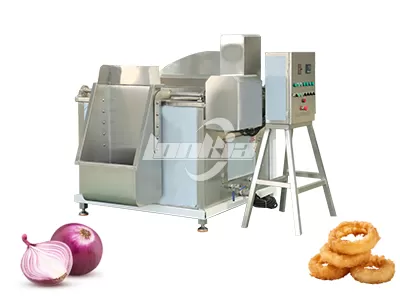
1. Operating Method
Batch-type equipment operates on a batch-by-batch basis:
Each batch of ingredients must be fully fried before the next batch can be processed.
2. Advantages
- Relatively low equipment costs
- Flexible operation, suitable for producing a wide variety of products
- Ideal for small-scale or pilot production stages
3. Limitations
- Significant fluctuations in oil temperature after loading
- Product color and texture may vary
- Requires a higher degree of manual intervention
From a practical production perspective, this type of industrial deep fryer is better suited for scenarios with lower output requirements.
Advantages of Continuous Deep Fryers
1. Continuous Production for Increased Efficiency
Continuous frying equipment uses a conveyor belt to continuously feed materials into the oil tank, enabling uninterrupted production without waiting for the previous batch to finish
2. Stable Temperature Control, Ensuring Quality
The continuous deep fryer is equipped with an automatic temperature control system that maintains a constant oil temperature, thereby ensuring:
- Consistent color
- Stable texture
- Standardized finished products
3. High Degree of Automation
Continuous fryers typically integrate:
- Automatic conveying systems
- In-line filtration systems
- Oil circulation systems
This not only reduces manual labor but also enhances overall production efficiency
4. Improved oil management
Through filtration and oil-water separation designs:
- Extended oil service life
- Reduced oil consumption
- Enhanced equipment operational stability
Which Industrial Deep Fryer Is Right for You?
| Comparison Criteria | Continuous Deep Fryer | Batch Deep Fryer |
| Production Method | Continuous operation | Batch processing |
| Temperature Stability | High | Significant fluctuations |
| Product Consistency | High | Prone to inconsistencies |
| Labor Requirements | Low | Higher |
| Suitable Scenarios | Stable, large-scale production | Flexible, small-batch production |
How to Choose the Right Industrial Deep Fryer Machine?
If your priorities are:
- ✔ Consistent output: Continuous industrial deep fryers are better suited for long-term operation
- ✔ Product consistency: Temperature control systems in continuous equipment are more reliable
- ✔ Cost control: Although the initial investment is higher, continuous equipment offers advantages in labor and oil consumption
- ✔ Flexibility: If product varieties change frequently, batch-type equipment is easier to adjust
Equipment Selection Recommendations
For most food processing companies, as production volume increases, they will gradually transition to continuous deep-frying systems. This is not only an equipment upgrade but also an optimization of the production model.
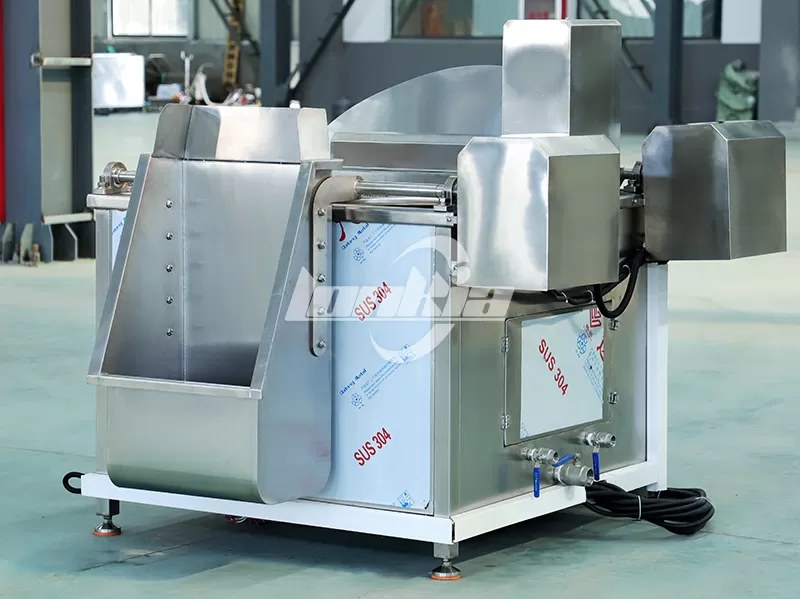
Equipment like Lonkia, which continuously optimizes structural design and temperature control systems, has already achieved a good balance between stability and automation, making it easier to achieve standardized output in actual production.
Summary
From a long-term production perspective, continuous industrial deep fryers offer clear advantages in efficiency, quality, and stability, while batch-type equipment is better suited for initial stages or flexible production needs.
If your goals are:
👉 To increase production capacity
👉 To stabilize product quality
👉 To reduce reliance on manual labor
Then choosing a continuous industrial deep fryer would be a more forward-thinking solution.