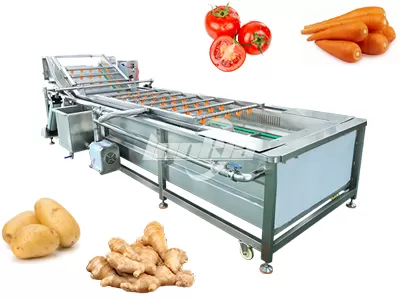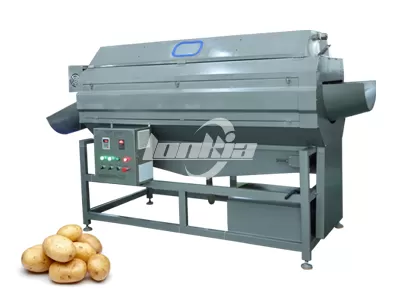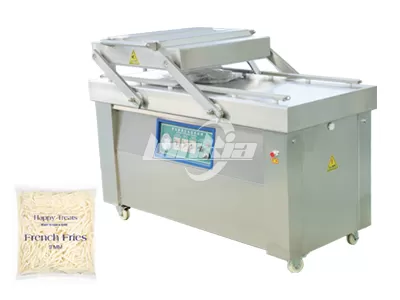
In the processing of fruits and vegetables, washing is a critical step that affects the quality of subsequent processing. If dirt, sand, impurities, and other debris on the surface of raw materials are not effectively removed, they may interfere with subsequent processes such as cutting, freezing, and packaging. As a result, an increasing number of food processing companies are adopting bubble washers to replace traditional washing methods, thereby achieving more stable and efficient continuous washing. Bubble-type fruit and vegetable washers primarily achieve thorough cleaning of produce surfaces through a combination of bubbles, tumbling water flow, and spray rinsing.
How Does a Bubble Washer Machine Work?
The core operating principle of a bubble washer machine is to use air to generate a large number of tiny bubbles, causing the fruits and vegetables in the tank to continuously tumble and move. During the cleaning process, the bubbles rise and burst, creating impact force while simultaneously agitating the water flow, causing mud, dust, and impurities adhering to the surface of the produce to gradually detach.
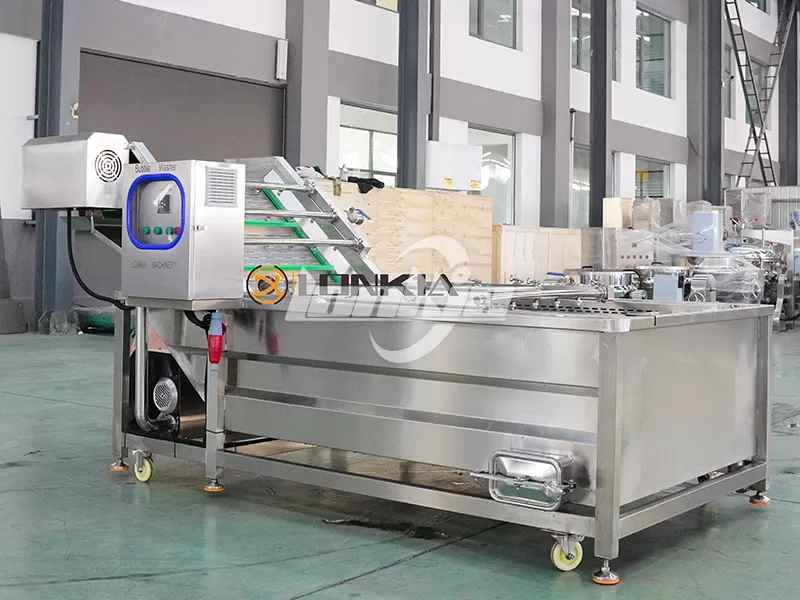
The specific workflow is as follows:
1. Produce Enters the Washing Tank
The fruits or vegetables to be washed enter the equipment's tank through the feed inlet. Depending on the characteristics of different products, operators can adjust the conveyor speed to ensure the produce remains in the water for an appropriate cleaning duration.
2. Cleaning via the Bubble Generation System
A bubble generator is installed at the bottom of the equipment, continuously injecting air to produce a large number of bubbles. The combined action of the bubbles and the water flow ensures the product is evenly tumbled in the water, preventing any areas from being left without water contact.
Compared to simple spray washing, the bubble washer machine ensures thorough water contact with the product's surface, making it more suitable for cleaning fruits and vegetables with irregular shapes or surfaces prone to harboring dirt.
3. Secondary Rinsing via the Spray System
After bubble washing, the produce enters the spray zone, where clean water is sprayed to further remove residual impurities, ensuring a more consistent cleaning result.
4. Discharge via the Conveyor System
Once cleaning is complete, the produce is conveyed via a mesh belt to the next processing stage—such as slicing, sorting, blanching, freezing, or packaging—enabling seamless integration with the entire production line.
Main Structural Components of a Bubble Washer Machine
For food processing companies, the equipment's structure directly impacts cleaning effectiveness and long-term operational stability. A complete bubble washer machine typically includes the following core components:
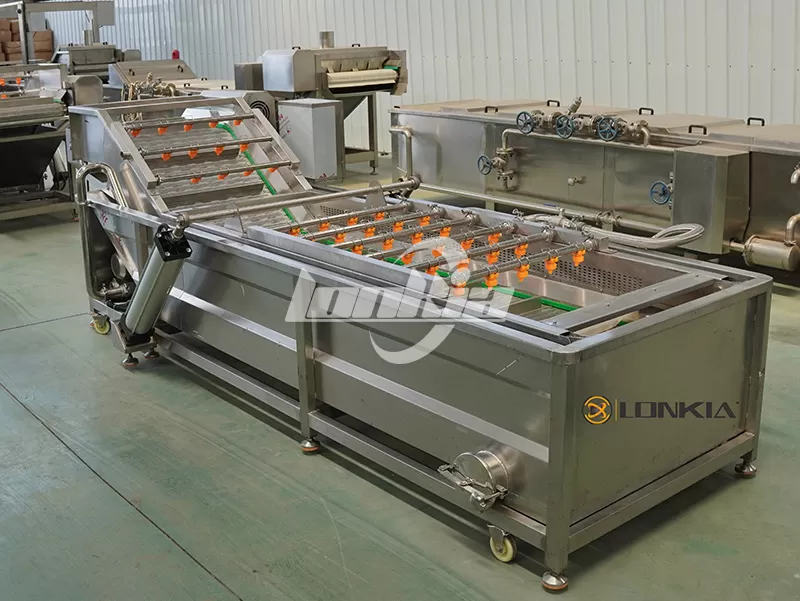
- Bubble Generation System: This is the key component that enables gentle cleaning. By uniformly generating bubbles, it allows the products to tumble thoroughly in the water while minimizing damage caused by mechanical impact.
- Washing Tank: The tank provides a stable washing environment; a well-designed water flow pattern helps separate impurities and improves overall cleaning efficiency.
- Conveyor Belt: The conveyor system controls the speed at which products move through the equipment. Conveyor time can be adjusted according to the characteristics of different raw materials, ensuring that both soft and hard products achieve optimal cleaning results.
- Spray System: The spray system is primarily used to complete the final rinse step, further enhancing the cleanliness of the product surface.
Lonkia's bubble washer incorporates food processing equipment design principles, combining bubble washing, conveying, and spraying functions. The equipment can be configured according to customers' processed products and production processes, providing stable cleaning solutions for fruit and vegetable processing enterprises.
What products can the Bubble Washer Machine clean?
The bubble washer machine has a wide range of applications and is suitable for various fruit and vegetable processing scenarios, such as:
- Root vegetables such as potatoes and carrots
- Leafy vegetables such as lettuce, spinach, and cilantro
- Fruits such as tomatoes, strawberries, and grapes
- Ingredients for salad production
- Ingredients for frozen vegetable production lines
Different products have varying requirements for cleaning intensity and duration; therefore, when selecting equipment, it is necessary to configure the system appropriately based on the characteristics of the raw materials, production capacity, and subsequent processing steps.
Why Do Food Processing Companies Choose Bubble Washer Machines?
For food manufacturers requiring continuous processing, manual washing is not only inefficient but also prone to variations in cleaning quality due to operator skill. Bubble washer machines ensure a more consistent cleaning standard for each batch through automated operation.
Its main advantages include:
- Continuous washing, improving processing efficiency
- The bubbling action minimizes product damage
- Suitable for a wide variety of fruits and vegetables
- Can be integrated with other processing equipment to form a complete production line
- Simple structure, easy to operate and maintain
Conclusion
For food companies seeking to improve the efficiency of fruit and vegetable processing and ensure consistent product quality, selecting the right bubble washing equipment is a crucial step in establishing a highly efficient production process. By properly configuring the bubble washer machine, companies can lay a more reliable foundation for raw material processing in subsequent stages of production.