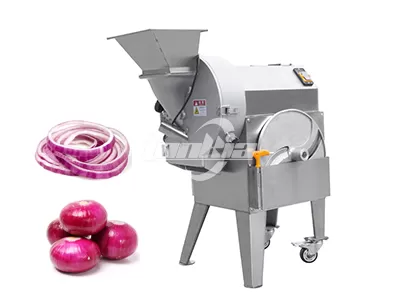
Chopping onions may seem simple, yet it consumes significant time and labor in actual production. For food processing, production lines, and central kitchens, dicing speed and consistency directly impact overall production efficiency and product quality. Compared to traditional manual dicing, the advent of onion dicer machines has revolutionized onion preparation, providing a highly efficient and reliable solution for modern food processing.
Limitations of Manual Dicing: Low Efficiency and Variability
Traditional manual dicing relies on skilled knife work, requiring workers to slice each piece individually, creating clear bottlenecks:
- Limited Efficiency: Variable hand speeds among workers lead to significant hourly output fluctuations, making it difficult to meet high-demand scenarios.
- Unstable Quality: Inconsistent dicing sizes affect subsequent cooking times and finished product uniformity.
- High labor costs: Sustained high staffing levels increase operational expenses, particularly during peak periods.
These challenges are real obstacles food processing businesses face when scaling production or handling order surges.
Advantages of the Onion Dicer Machine: Speed and Consistency
Compared to manual dicing, the value of an automatic onion dicer machine is clear:
1. High-efficiency Output
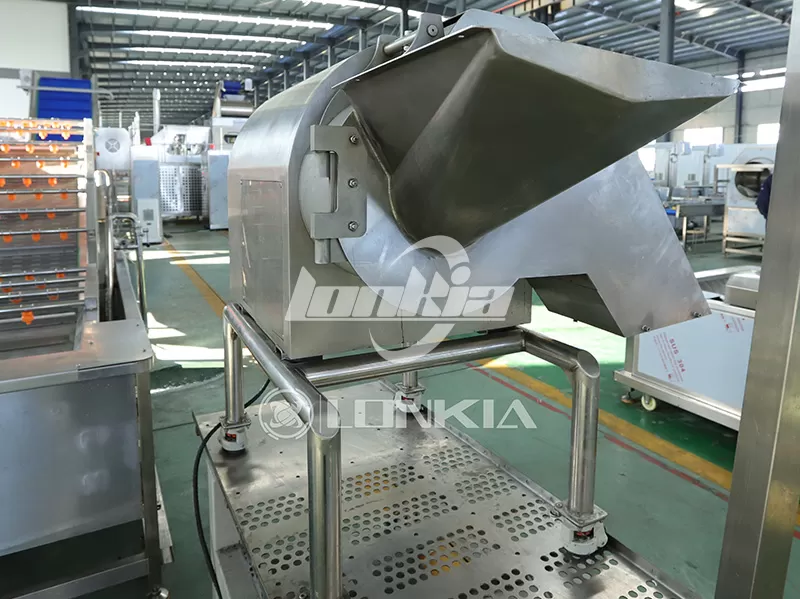
The onion dicing equipment employs an automated feeding system and precision cutting mechanism to simultaneously remove onion ends and dice the bulb, significantly accelerating dicing speed. Its continuous operation mode meets high-volume production demands—crucial for lines requiring substantial dicing—while eliminating efficiency losses from manual fatigue. It replaces traditional manual processing with speed and consistency, effectively boosting overall production rhythm.
2. Uniform Dicing Size
The onion cube cutting machine incorporates standardized cutting dies, ensuring each onion cube maintains consistent dimensions and shape. This uniformity is vital for subsequent processing steps (such as frying or mixing), as it guarantees even heat transfer and cooking times. The result is a more stable product yield and texture, meeting food processing standards.
3. Intuitive Operation
The onion dicer machine features an intuitive interface, allowing even novices to master it quickly. Compared to the extensive training time required for manual labor, using an automatic onion dicer significantly reduces reliance on skilled workers and boosts on-site operational efficiency.
4. Food Safety and Hygiene Advantages
Constructed entirely from food-grade stainless steel, the onion cut machine is easy to clean and sanitize. Unlike manual operations involving frequent direct contact with raw materials, the automated process drastically minimizes the risk of human contamination, better meeting the stringent hygiene standards demanded by the food processing industry.
Application Scenario Comparison
Manual dicing may still be preferred in small-batch, low-frequency settings like home kitchens or restaurants. However, in production environments demanding high output, consistent quality, and reduced labor costs, onion dicer machines offer substantial advantages over manual methods. These distinct differences are driving increasing adoption of industrial onion dicing equipment among food processors seeking enhanced efficiency and product consistency.
| Comparison Item | Manual Dicing | Automatic Onion Dicer Machine |
| Production Efficiency | Low | High |
| Dicing Consistency | Unstable | Consistent and Efficient |
| Operational Safety | High Risk | Low Risk |
| Suitable Scenarios | Small Batches | Batch / Factory Processing |
Conclusion: Why Onion Dicing Machines Are the Trend?
Automatic onion dicer machines comprehensively outperform manual dicing in efficiency, product consistency, ease of operation, and food safety. For businesses pursuing high-efficiency production, stringent quality control, and reduced long-term labor investment, this represents a worthwhile equipment investment.
For instance, Lonkia's automatic onion dicing machine not only supports high-speed dicing but also features a modular design and easy maintenance, meeting modern onion production lines' demands for automation and stability.